
Trade Effluent Support
Information to guide and support your business ahead of regulatory changes to trade effluent charges on 1st October 2026.
Trade Effluent FAQs
Trade Effluent Essentials Programme
Our complementary, 30 minutes introductory online course, in conjunction with Sustainable Enterprise Skillnet, is designed to help SMEs understand trade effluent requirements, water quality and compliance. This short course provides the essential information to help you manage trade effluent effectively. It covers:
- How trade effluent impacts costs, operations and the environment
- How to know if your business requires a licence from Uisce Éireann
- Practical ways to reduce effluent strength, volume and charges
The Introduction to Trade Effluent Stewardship Workshop
In collaboration with the Sustainable Enterprise Skillnet, Uisce Éireann also offers a 1.5 hour online workshop called Introduction to Trade Effluent Stewardship. The content of this workshop will help you to safeguard water quality, meet reporting requirements and prepare for trade effluent charges that will come into effect on 1st October, 2026. In addition it provides a practical introduction to the more in-depth 8-week Trade Effluent Stewardship Programme (detailed below).
Trade Effluent Water Stewardship Programme
Our 8-week programme to support trade effluent customers to manage water quality, reduce costs and comply with upcoming regulations.
For more on conservation, testimonies and funding options to improve environmental performance, see water conservation for business.
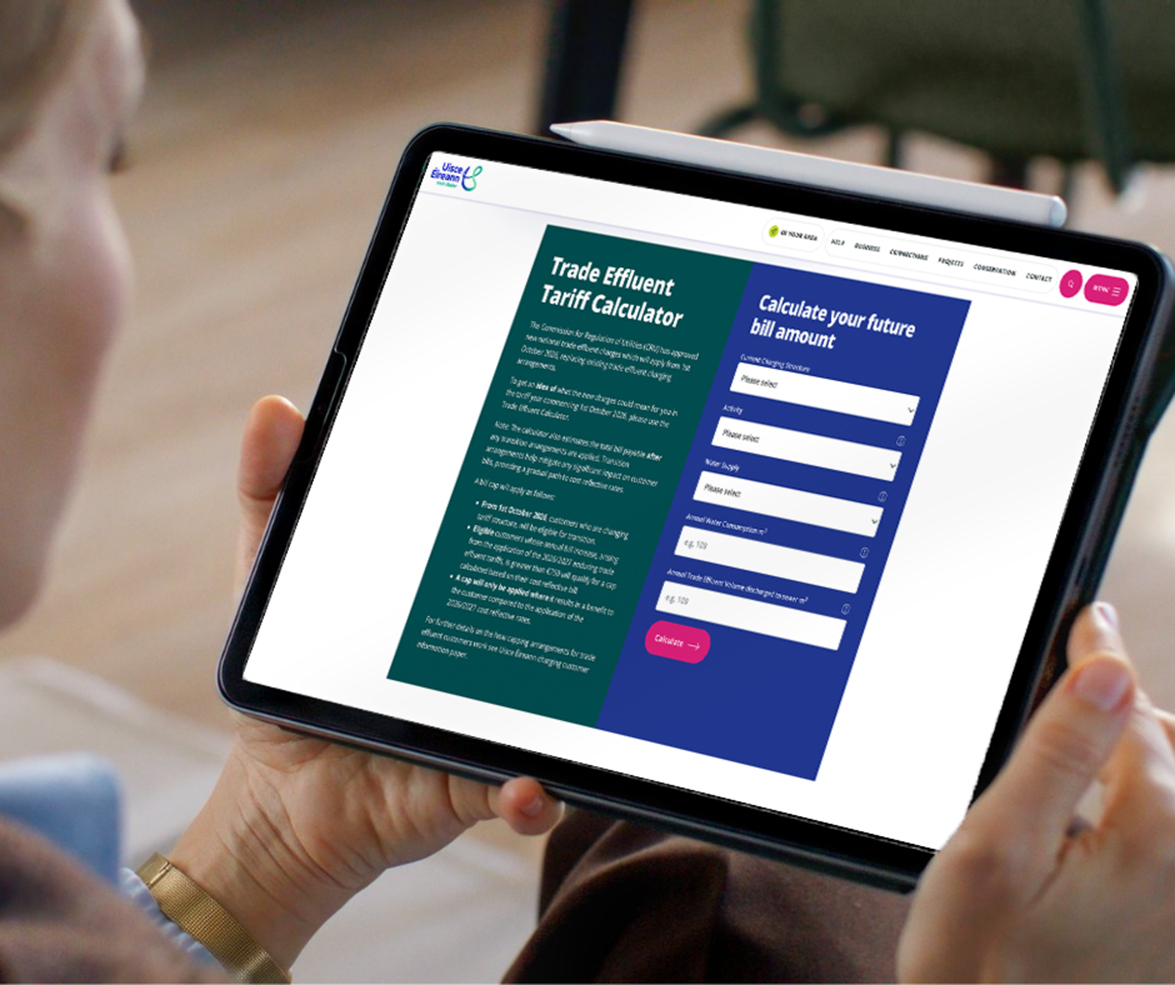
Trade Effluent calculator
The trade effluent calculator helps business customers understand the new charging framework ahead of the changes coming into effect on 1st October 2026.
Licence application forms
Trade licence application form
Irish law requires Uisce Éireann or the Environmental Protection Agency to regulate trade effluent discharges into the sewer network. For more on trade effluent licensing, see the trade effluent licence page.
Discharging trade effluent without a licence is an offence and legal action may follow if a valid licence is not in place.
Fat, oils and grease (FOG) licence application form
If your business discharges fats, oils or grease, it is a legal requirement to have an up-to-date FOG licence. It can prove costly to remedy FOG blockages, so it is important for food service establishments to understand how to dispose of fats, oils and grease properly.
Find more information on fats, oils and grease disposal.
Sector guidance documents
In preparation of the new trade effluent charging arrangements coming into effect from 1st October 2026, we have launched four new sector guidance documents to help businesses prepare for the changes.
Each document contains industry specific information on pollutants, prevention, treatment, monitoring and reporting, and practical tips to manage trade effluent.
The industries include:



Trade Effluent Customer Guidance Booklet
We have created a new guide for you to explain what is changing, what it means for your business and how your charges will be calculated. We have included a range of practical tools and details on fully funded support to help you understand and manage trade effluent on your site.