Lead in drinking water
Lead in drinking water is a known health concern. There are no lead water mains in Ireland but there are still some lead service connections remaining in the public network.
What work we are doing now?
Uisce Éireann Lead Sampling Pilot Programme
Uisce Éireann is conducting a pilot lead testing program in three Central Dublin locations: Phibsborough, North Wall and the South Circular Road to ensure water safety. Due to the age of the network, there may be lead present within the service connection and/or the private supply pipe, and testing helps us confirm this. We will carry out random daytime sampling with approximately 600 houses.
Within each area, we will randomly select properties across three age cohorts - pre 1970, 1970–1980 and post 1980 - and residents chosen for participation will be voluntary, and no personal data will be published. Results are used in aggregate for mapping and planning. We will update customers if the testing confirms the presence of lead within their property. Uisce Éireann will then replace any lead that is present on the Service connection. If lead is found in the home’s plumbing, customers may qualify for a grant of up to €5,000 to help replace pipes. We’ll give you all the details on this programme.
Further information on the Government grant can be found on the Domestic Lead Remediation Grant Scheme page.
Health risk of lead
Regular consumption of even low levels of lead can have negative health effects. The greatest health risk is for babies in the womb, infants and young children. Bottle-fed infants are especially at risk because they are fed with formula, which you make with drinking water.
The legal limit for lead in drinking water has been reduced over time. It is now at a very low level of 10µg/L or 10 microgrammes per litre.
How lead can get into drinking water
As drinking water leaves the treatment plant, it contains little or no lead. However, when drinking water comes in to contact with lead service connections, lead can dissolve into it. The amount of lead which dissolves into drinking water can depend on:
- the length of lead service connection work the water passes through
- the length of time the water sits in the lead service connection
- the temperature of the water
- whether your water is hard or soft
Check your home or property for lead service connections
You can't taste, smell or see lead in drinking water. To check for lead service connections you should do two things:
- Look at the age and plumbing history of your property
- Inspect your existing pipes and fittings
Why the age of your property matters
Builders and plumbers often used lead for plumbing up to and including the 1970s. If your property dates from before 1970 and still has the original internal plumbing, you may have lead service connections or fittings.
How to inspect existing pipes
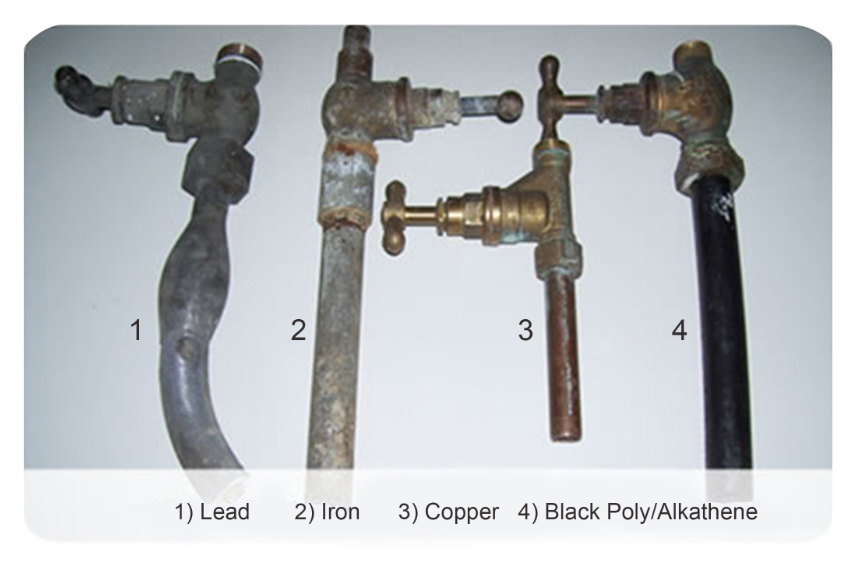
Find the water pipe where it enters your property and runs to the kitchen tap. Do this even if your internal plumbing has been upgraded or replaced, as this may still be a lead service connection. Then, use this guide to check the colour and appearance of the pipe. Try to inspect as much of the pipe as possible. If in doubt, contact your local plumber.
| Colour | Appearance / density | Material |
|---|---|---|
| Dark grey or black with a dull coating (unless painted) | Joints appear swollen Shiny silver when scraped with a knife | Lead |
| Dark, may be rusty | Very hard | Iron |
| Brown/orange colour, can be bright or dull | Hard | Copper |
| Grey, black or blue | Hard | Plastic |
Who is responsible for what pipes?
Test your water for lead
You can have your tap water tested for lead. You'll need to organise this yourself. We recommend you use an accredited laboratory. Find one through the Irish National Accreditation Board, the United Kingdom Accreditation Service (UKAS) or similar.
A single test for lead in water may not provide a full picture of lead levels in the property's drinking water. The amount of lead in water is influenced by factors such as:
- pipe length
- the standing time of the water
- temperature
- the chemical makeup of the water
If tests show lead in your drinking water, that doesn't mean the entire water supply is affected. The issue relates to the property, not the water supply.
Taking samples
You should take 3 samples of water from the tap.
- After the water has been sitting for at least 30 minutes, but preferably overnight.
- After running the tap for 1 minute.
- After running the tap for 5 minutes.
The results from this testing should give you a good idea if running the tap will reduce lead levels to within safe limits.
Precautions to take
Use these precautions if you think you have lead in your water and haven't fixed the issue. Boiling water doesn't remove lead from water.
Use the cold water tap or bottled water
- Only take water for drinking, cooking and making baby formula from the cold water tap in your kitchen. Make sure that this water comes straight into your house from the water mains.
- Don't drink water from the cold water tap in your bathroom as this usually comes from a tank in your attic.
- Use bottled water. If you are making infant formula or food, avoid using bottled water labelled as Natural mineral water. This water can have high levels of sodium (salt) and other minerals. Natural mineral water can be used for a short time to prepare infant formula or food if no other water is available.
Run your water before use
The longer water has been sitting in the pipe, the more likely lead will dissolve into it. Run or flush the tap before using it for drinking or cooking. Doing this may lower the level of lead. However, the only way to know if this works is to have your water tested for lead before and after running the tap.
If flushing does not reduce lead
If testing shows that running your tap doesn't reduce lead levels below the 10µg per litre limit.
- Use drinking water from another source, especially for pregnant women, bottle-fed infants and young children.
- You can use the water for toilet flushing, showering and bathing, laundry and dishwashing.
Replacing lead service connections
You should replace any lead service connections or fittings inside your house.
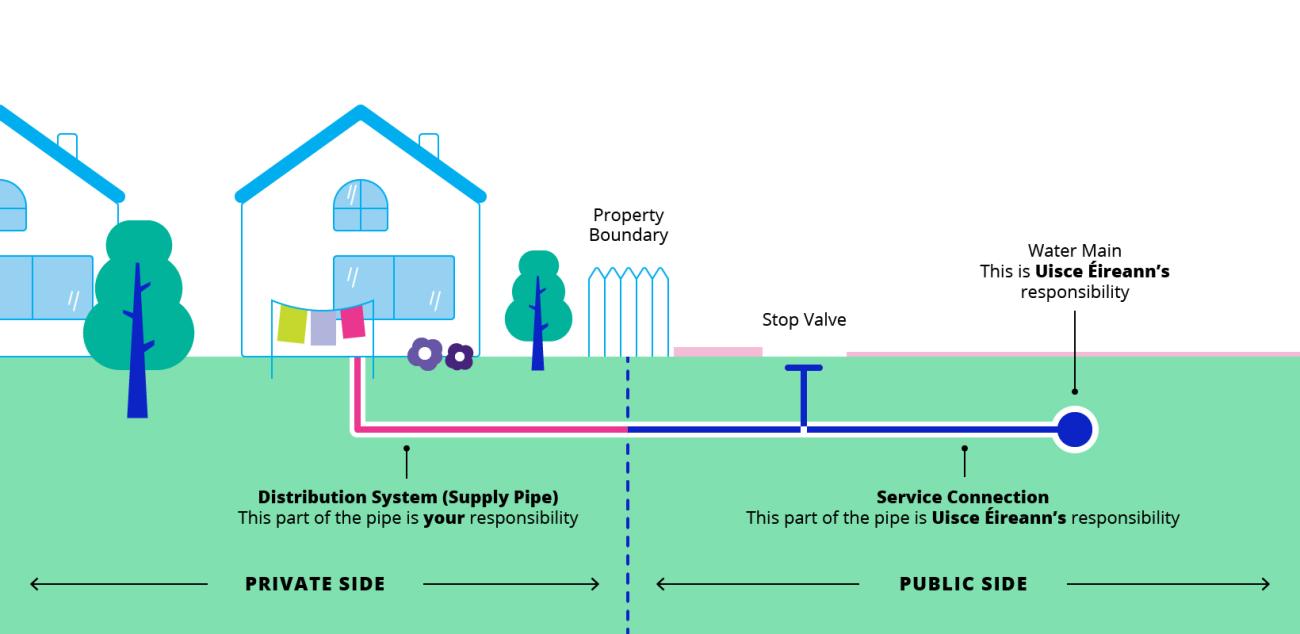
Which pipes are your responsibility
You're responsible for the internal plumbing in your home and the connecting pipe from the outer edge of the property boundary. This is called the private side. Other types of connections, for example, where the connection is shared or comes through the back garden, exist but are rare. See who's responsible for which pipes.
Lead service connection replacement scheme
You can apply to have a lead public service connection pipe replaced free of charge. To qualify you must have replaced your lead private supply pipe.